

Terracotta Army: tickets, early access, and how to pace the visit
·Updated
The Terracotta Army has a strange reputation. Half the travellers we talk to say it is the most extraordinary thing they have ever seen. The other half say it was a disappointment. Both are telling the truth, because they are describing different products. The site rewards a slow visit. It punishes a fast one. The question is how to make sure you get the first version.
Why the rushed version is the famous version
Most overseas tours run Terracotta as a half-day from Xi'an. The bus leaves the hotel at 08:30, arrives at the site car park at 09:30, the group enters Pit 1 by 09:50, the guide gives a 20-minute commentary in front of Pit 1, the group moves to Pit 3 for ten minutes, walks past Pit 2 without entering, glances at the bronze chariots, and is on the bus again by 11:30 for the lunch stop on the way back.
That version of the site is about 75 minutes of looking. There is no time for the museum hall (where most of the conserved warriors live at body-distance), no time for the bronze chariots gallery (which is arguably the strangest object at the site), and no time for Pit 2 (which is where the cavalry, kneeling archers, and standing crossbowmen are).
The reason tour operators run this version is straightforward economics. The bus carries 35 people. It needs to do two stops before lunch and two more after. The site gets the shortest viable visit so the day stays on schedule. Whatever the brochure says about a "full visit," the bus timetable is what actually constrains you.
What three hours buys you
The site has a natural order that the rushed version skips. We brief every traveller to take it in this sequence.
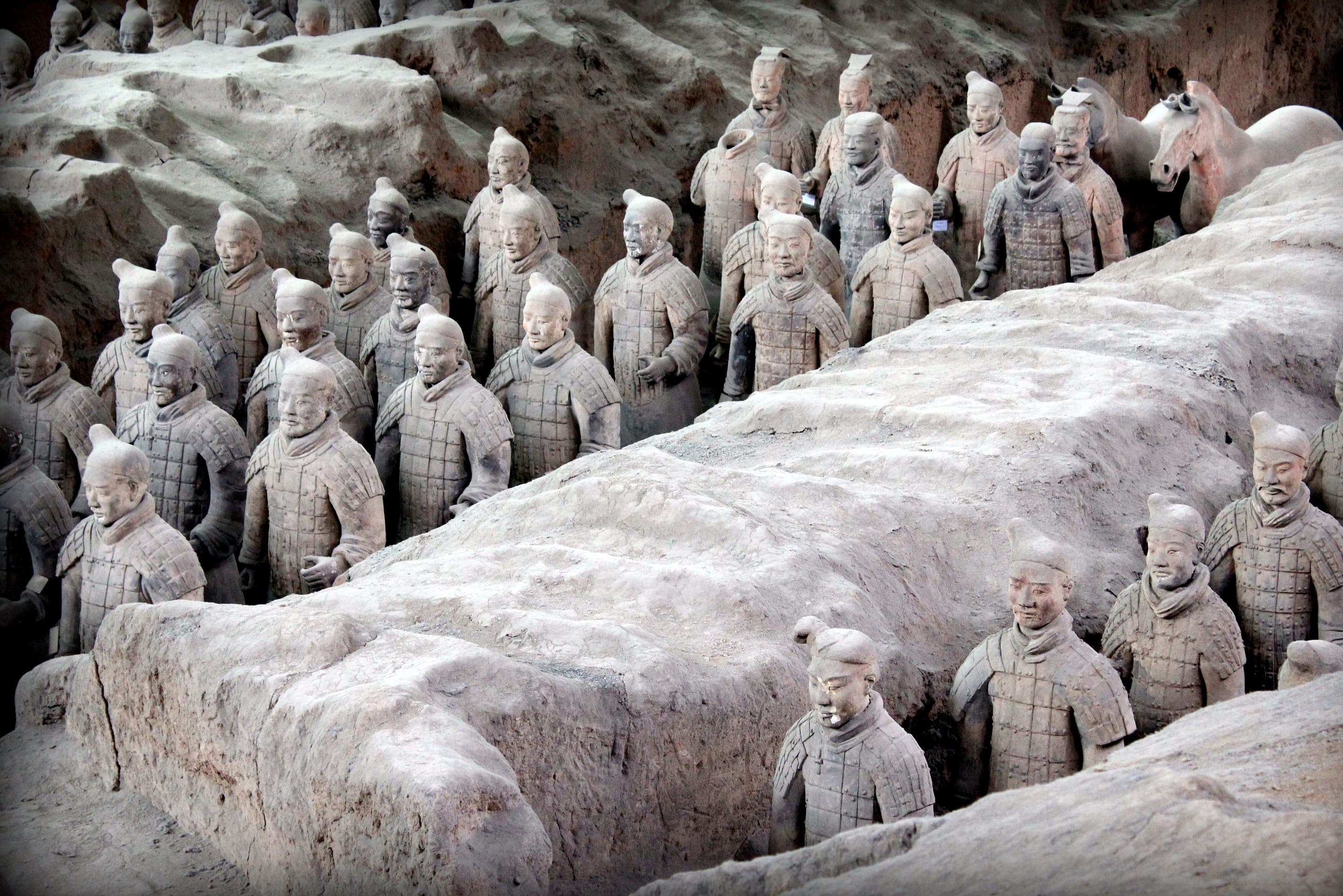
- Museum hall first (40 min). Before you enter the pit buildings, the museum hall contains the conserved warriors at body-distance behind glass. This is where you read the faces. Once you have done this, the figures in the pits stop being a uniform army and become a population of individuals.
- Pit 1 (45 min). The famous one. The reason to give it 45 minutes is that the front section is the most reconstructed, and the back two thirds are where the in-progress excavation work is visible. Walk the full perimeter; the long sides reward it.
- Pit 3 (20 min). The command pit. Small, dim, easy to miss. The figures here are different. Take the time.
- Pit 2 (35 min). The most varied figures. Kneeling archers, cavalry, horses. Less famous than Pit 1, more rewarding figure-by-figure.
- Bronze chariots gallery (20 min). Two half-scale bronze chariots, discovered in 1980 in a separate pit and now displayed in a dedicated building. They are technically more sophisticated than anything else on site. Almost no day tour visits them.
The bronze chariots are the moment most travellers tell us, afterwards, was the part they did not expect.
This sequence is roughly three hours including transitions. It is the version a private trip can build the day around. We book the first entry slot at 08:30 and take the museum hall first, so we reach Pit 1 well before the coach groups get to the gate.
Tickets, in practical detail
Tickets are booked by real-name reservation via the official Emperor Qinshihuang's Mausoleum Site Museum portal. The booking needs a valid identity document, which for foreign visitors means your passport, and the official guide page asks visitors to book online before travelling to the site. The booking flow is built for domestic travellers, which is the part that trips up most overseas visitors. There are three workable paths.
- A local operator (us, in the trips we arrange, or any reputable Xi'an inbound agent) books on your behalf using a Chinese ID and prints the timed-entry confirmation against your passport details for collection on the day.
- A hotel concierge at one of the international-brand hotels in central Xi'an will book on your behalf for a small fee, provided you give them your passport details 4 to 7 days in advance.
- A growing number of online ticket agents accept overseas cards. Quality varies. We have a list of ones we have used and which have not added phantom surcharges.
Sources: Official site museum portal · Official guide and ticketing page
What about the rest of the imperial site
The Terracotta Army is part of a larger site that also includes the unexcavated tomb mound of Qin Shi Huang himself, about 1.5 km away. The mound is closed to excavation by Chinese government policy (the soil and mercury readings around it suggest the unopened tomb is intact and the technology to excavate without damaging it does not yet exist). You can walk the surface, which is a hill with a path around it.
Most travellers skip the mound. We sometimes include it, in the version of the day that has a relaxed afternoon, because standing on the surface of an unopened imperial tomb is its own quiet experience. It is not, however, the photo most people came for.
The honest summary
The Terracotta Army is one of the two or three most consequential archaeological sites in the world. It rewards three hours and punishes ninety minutes. The travellers who say it is overrated are telling the truth about the version they got. The travellers who say it is unforgettable are also telling the truth, about a different version. The version you get depends on how you book the day.
For the broader Xi'an pacing question, the how many days in Xi'an piece is the natural next read.
Sources
- Emperor Qinshihuang's Mausoleum Site Museum: Official site. Verified 2026-07-04.
- Emperor Qinshihuang's Mausoleum Site Museum: Guide and ticketing page. Verified 2026-07-04.
- UNESCO World Heritage Centre: Mausoleum of the First Qin Emperor. Verified 2026-07-04.
Frequently asked questions
Yes. Entry is by real-name reservation via the official Emperor Qinshihuang's Mausoleum Site Museum portal, booked against a valid identity document (your passport, for foreign visitors). The official guide asks visitors to complete the online booking before travelling to the museum, so do not rely on buying at the gate.
Related reading
How many days do you need in Xi'an?
Three days, for most travellers. Here is what each day actually buys you on the ground.
Best time to visit China
The warriors are inside a temperature-controlled hall, so the season matters less for the site than for the bus ride out and back.
China's 30-day visa-free scheme (2026)
30 days without a visa application, for Australian, British, Canadian and New Zealand passports. The practical entry rules before you book.
Xi'an: the destination page
The warriors in context: city wall, Tang Paradise, Huaqing, Big Wild Goose Pagoda, and the rest of the dynasties Xi'an held.
If this is the kind of trip you're imagining, let's design yours.